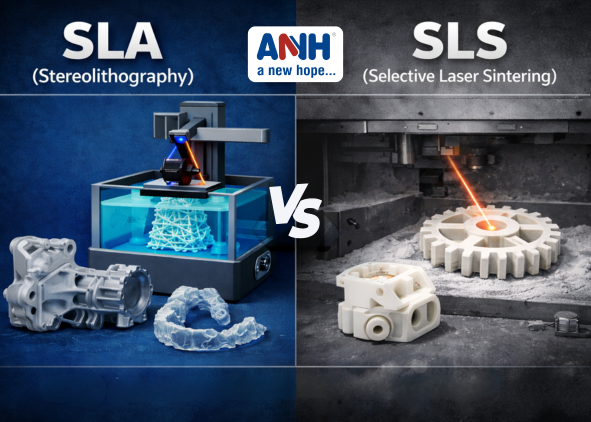
Choosing the right 3D printing technology can make or break your product development process. Whether you’re a startup building a prototype or a manufacturer optimising production, understanding the difference between SLA andSLS 3D printing is crucial.
Both technologies are widely used in industrial applications, but they serve very different purposes. SLA (Stereolithography) is known for a smooth surface finish, while SLS (Selective Laser Sintering) is preferred for a strong, matte, slightly rough texture.
What is SLA 3D Printing?
SLA 3D printing is a 3D printing technology that uses a UV laser to cure liquid resin into solid layers. It’s known for delivering exceptional detail and a smooth surface finish.
Understanding the difference between SLA vs SLS 3D printing helps you choose the right technology for your project.
SLA when you need a smooth surface finish, fine details and visual accuracy SLS when you need strong, functional parts with a matte and slightly rough texture
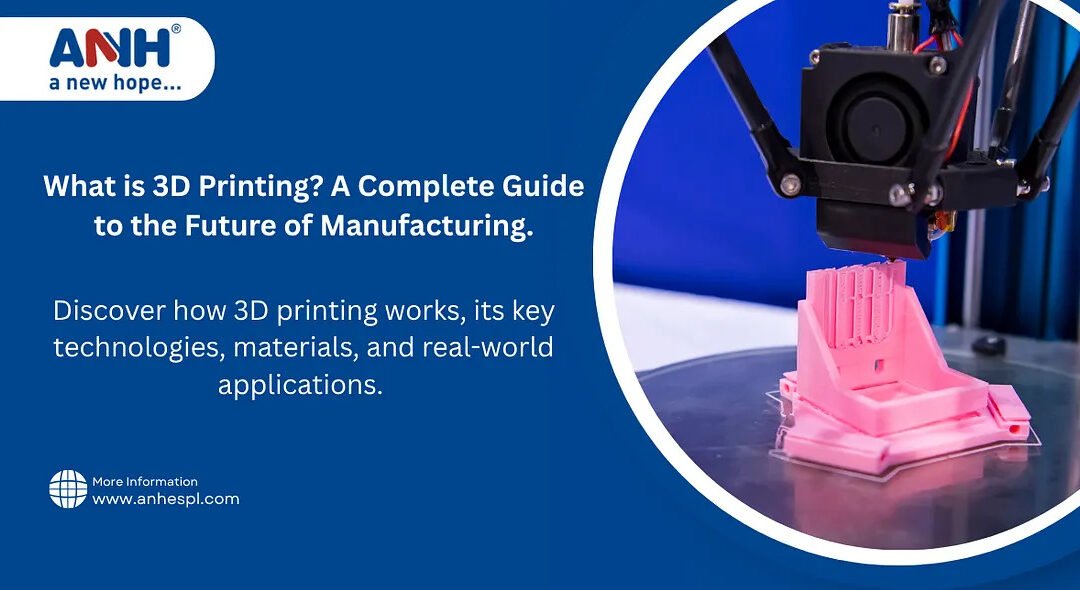
Manufacturing is evolving rapidly with the adoption of advanced digital technologies and 3D printing has become one of the most impactful innovations in modern engineering. From rapid prototyping to the production of complex industrial components, 3D printing is helping companies design, test and manufacture products faster and more efficiently.
Today, industries such as automotive, aerospace, healthcare and consumer goods are using 3D printing to reduce development time, lower production costs and improve design flexibility. Businesses that adopt additive manufacturing technologies gain a significant competitive advantage in the market.
Unlike traditional manufacturing methods that remove material from a solid block (subtractive manufacturing), 3D printing adds material precisely where it is required. This allows engineers to create highly complex designs with minimal waste and improved efficiency.
The process typically begins with a digital design created using advanced CAD software such as PTC Creo. The digital file is then converted into a format that a 3D printer can interpret. The printer builds the object layer by layer using materials like plastic, resin, metal powders or composite materials.
This innovative approach enables manufacturers to create prototypes, tools, and functional parts quickly while maintaining high precision and accuracy.
How Does 3D Printing Work?
The 3D printing process generally involves several important steps:
1. Designing the 3D Model
The first step is creating a digital design of the product using CAD software. Engineers design the component with accurate dimensions and specifications.
2. Converting the Design into Printable Format
Once the design is complete, it is exported into a file format such as STL or 3MF. This file is then sliced into thin layers using specialized slicing software.
3. Printing the Object
The 3D printer reads the sliced file and deposits material layer by layer according to the design. Each layer bonds with the previous layer until the object is fully formed.
4. Post-Processing
After printing, the part may require additional finishing processes such as cleaning, curing, sanding, or polishing to achieve the desired quality and strength.
This streamlined workflow enables companies to move from design to physical product much faster than traditional manufacturing processes.
Types of 3D Printing Technologies
Different types of 3D printing technologies are used depending on the application and materials required.
FDM (Fused Deposition Modeling)
FDM is one of the most widely used 3D printing technologies. It works by melting thermoplastic filament and depositing it layer by layer to create the final object. This technology is commonly used for prototypes and functional parts.
SLA (Stereolithography)
SLA printing uses liquid resin that is cured using a laser or ultraviolet light. It produces highly detailed and smooth surface parts, making it ideal for precise prototypes and design models.
SLS (Selective Laser Sintering)
SLS technology uses a laser to fuse powdered materials together to form solid objects. It is widely used in industrial manufacturing for its ability to produce durable, complex parts.
Each of these technologies has unique advantages and is selected based on the project requirements.
Benefits of 3D Printing in Manufacturing
3D printing offers several advantages that are transforming the way products are designed and manufactured.
Faster Prototyping
One of the biggest benefits of 3D printing is rapid prototyping. Engineers can quickly produce and test prototypes, allowing them to identify design improvements early in the development process.
Cost-Effective Production
Traditional manufacturing often requires expensive moulds and tooling. 3D printing eliminates the need for such tooling, making it more cost-effective for prototypes and small production runs.
Design Flexibility
3D printing allows engineers to create complex geometries that would be difficult or impossible to achieve using traditional manufacturing methods.
Reduced Material Waste
Additive manufacturing uses only the material required, reducing waste and supporting more sustainable manufacturing practices.
Customization
Another major advantage is the ability to produce customized parts without significant changes to the production process.
Industries Benefiting from 3D Printing
3D printing is now widely used across many industries due to its versatility and efficiency.
Automotive Industry
Automotive manufacturers use 3D printing for rapid prototyping, tooling, and the development of lightweight components.
Aerospace Industry
The aerospace sector uses additive manufacturing to produce lightweight and complex parts that improve fuel efficiency and performance.
Healthcare Industry
3D printing is used to produce customized medical devices, prosthetics, implants and surgical models.
Consumer Products
Product designers use 3D printing to test new concepts and accelerate product innovation.
Manufacturing and Engineering
Engineering companies rely on 3D printing for prototype development, design testing and product optimization.
Why Businesses Choose Professional 3D Printing Services
Although 3D printing technology is becoming more accessible, professional service providers offer several advantages.
Businesses prefer working with experienced service providers because they provide:
Access to advanced 3D printing technologies
High-quality printing and precision
Faster project turnaround time
Engineering design expertise
Cost-effective solutions for complex projects
Professional 3D printing services ensure that companies achieve the best results while saving time and resources.
ANHESPL — Best 3D Printing Services Provider in Delhi NCR
ANHESPL provides a wide range of services designed to support product development and innovation.
Key Services Offered by ANHESPL
High-quality 3D printing solutions
Rapid prototyping services
3D scanning and reverse engineering
Engineering design support
CAD modeling using advanced tools
Product development solutions
With extensive experience in engineering technologies and digital manufacturing, ANHESPL helps businesses turn their ideas into functional prototypes and innovative products.
By combining advanced technology with expert engineering support, ANHESPL ensures high-quality results and faster product development for its clients.
The Future of 3D Printing in Manufacturing
The future of manufacturing is becoming increasingly digital and 3D printing is expected to play a major role in this transformation.
Advancements in materials, automation and design technologies are enabling manufacturers to create stronger, lighter and more efficient components. As industries continue to adopt additive manufacturing, companies will be able to innovate faster and bring new products to market more quickly.
Organizations that embrace 3D printing today will gain a competitive advantage by improving efficiency, reducing production costs and enhancing product innovation.
Conclusion
3D printing is revolutionizing modern manufacturing by enabling faster prototyping, greater design flexibility and cost-efficient production. It allows businesses to accelerate product development while maintaining high precision and quality.
As industries continue to adopt additive manufacturing technologies, the demand for professional 3D printing services will continue to grow.
For businesses searching for the best 3D printing services provider in Delhi NCR, ANH Engineering Services (ANHESPL) offers reliable solutions to support innovation, product development and advanced manufacturing needs.
By partnering with ANHESPL, organizations can leverage cutting-edge 3D printing technology to transform their ideas into reality and stay ahead in today’s competitive market.
3D printing, also known as additive manufacturing, is transforming industries by making it easier, faster, and more affordable to produce everything from prototypes to fully functional parts. At ANH Engineering Services, we specialize in custom 3D printing services using the latest technologies for industrial, commercial, and educational applications.
How Does 3D Printing Work?
3D Designing — Using CAD software like AutoCAD, Creo, or SolidWorks.
Slicing — The design is sliced into layers by the slicer software.
Printing — A 3D printer builds the object layer by layer.
Post-Processing — Finishing steps like cleaning, curing, or polishing.
Types of 3D Printing Technologies
FDM (Fused Deposition Modeling)
Process: Melts and extrudes thermoplastic filament through a heated nozzle.
Materials: PLA, ABS, PETG, TPU
Use: Prototyping, hobby models, mechanical parts
Pros: Cost-effective, easy to use
Cons: Lower resolution than resin or powder-based prints
2. SLA (Stereolithography)
Process: Uses a laser to cure the liquid resin layer by layer.