BricsCAD® V26 New Features 2026, including AI-powered design tools, faster CAD performance, enhanced BIM workflows and expert support from ANH Engineering Services.
What’s New in BricsCAD V26?
BricsCAD V26 focuses on enhancing productivity, improving design accuracy and creating a smoother design-to-production workflow.
1. More Than 60 New Features and Enhancements
BricsCAD V26 introduces more than 60 new and improved capabilities across:
General CAD Design
Mechanical Design
BIM
Building Subcontracting
Land Surveying
These updates help engineers reduce repetitive tasks while improving overall design efficiency.
2. Enhanced User Interface
The latest version includes a cleaner and more intuitive interface with improvements such as:
With these enhancements, BricsCAD remains one of the strongest alternatives for professional CAD users.
Why Choose ANH Engineering Services?
ANH Engineering Services Pvt. Ltd. is a trusted authorised BricsCAD reseller in India, helping organisations adopt advanced CAD technologies with confidence.
Our BricsCAD services include:
BricsCAD Software Licensing
Software Upgrades
Installation & Deployment
Technical Support
User Training
CAD Migration Assistance
Corporate Solutions
Annual Maintenance & Consulting
With years of experience serving manufacturing, automotive, industrial equipment, aerospace, tooling and engineering companies, ANH provides complete CAD solutions backed by expert technical guidance.
Ready to Upgrade to BricsCAD V26?
Whether you’re looking to purchase a new license, upgrade from an older version or explore BricsCAD for your engineering team, ANH Engineering Services is here to help.
Our experts will help you choose the right BricsCAD edition, ensure a smooth implementation and provide ongoing support to maximize your productivity.
From rapid prototyping to end-use parts — how additive manufacturing is reshaping every industry, and why Delhi NCR businesses are embracing it now.
What Is 3D Printing? A Simple Explanation
3D printing is a process of creating three-dimensional objects from a digital file. Unlike traditional subtractive manufacturing — which cuts away material from a solid block — 3D printing builds objects layer by layer, adding material only where needed. This is why it is called additive manufacturing.
The process begins with a 3D digital model (CAD file), which is sliced into hundreds or thousands of thin horizontal layers by specialized software. The printer then deposits material — plastic, resin, metal or even biological matter — one layer at a time, until the final object is complete.
“3D printing doesn’t just change how things are made — it changes what can be made at all.”
Common 3D Printing Technologies
FDM — Fused Deposition Modelling
The most common and affordable method. Melts thermoplastic filament and deposits it layer by layer. Ideal for prototypes, functional parts, and educational models.
SLA — Stereolithography
Uses ultraviolet light to cure liquid resin into hardened plastic. Produces extremely high-detail, smooth-surface parts. Popular in dental, jewellery, and medical applications.
SLS — Selective Laser Sintering
Fuses powdered nylon or metal using a laser beam. No support structures needed. Excellent for complex geometries and functional end-use parts.
Metal 3D Printing (DMLS / SLM)
Builds metal parts directly from powdered alloys — steel, titanium, aluminium. Used in aerospace, defence, and medical implants where precision and strength are critical.
How 3D Printing Is Transforming Manufacturing
The manufacturing industry has traditionally relied on moulds, tooling, and large production runs. 3D printing fundamentally disrupts this model. Here are the most transformative ways it is reshaping production:
1. Rapid Prototyping — From Weeks to Hours
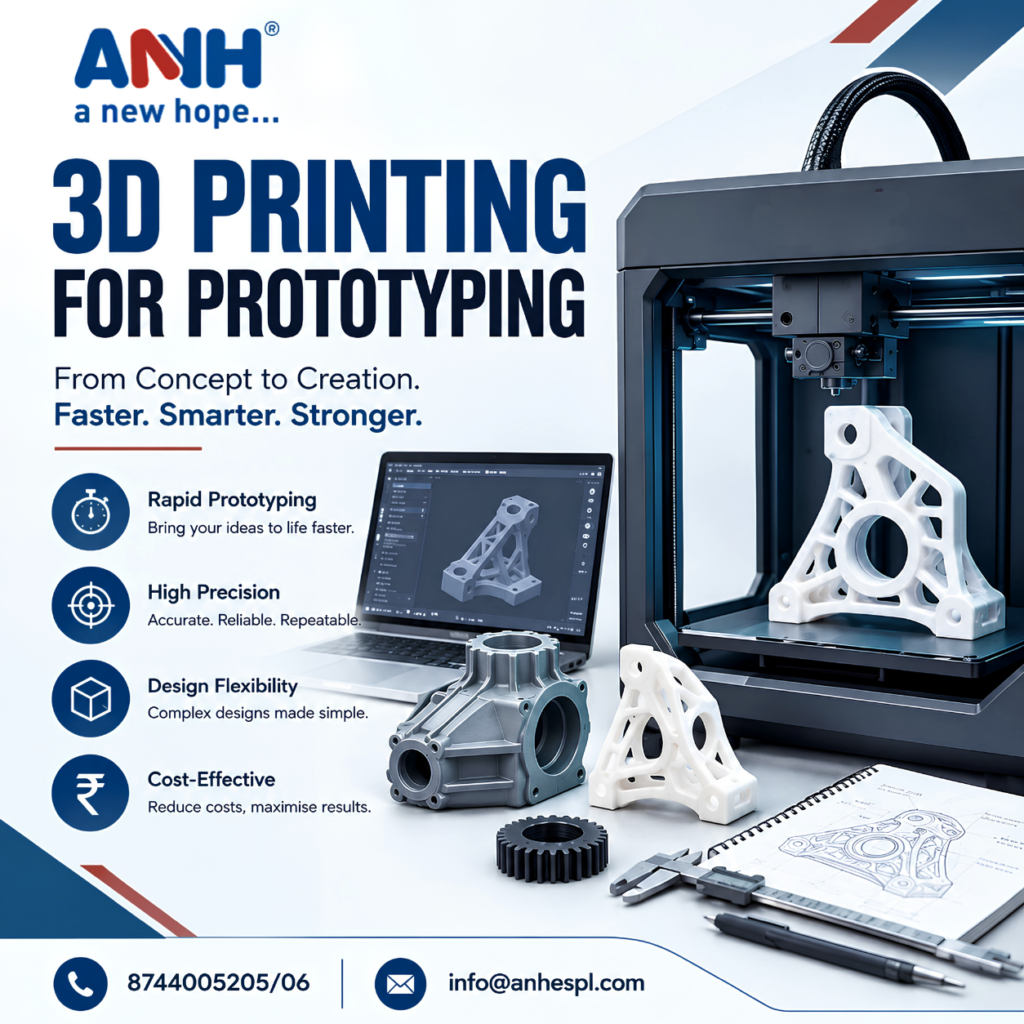
Before 3D printing, creating a prototype required expensive tooling, skilled machinists, and weeks of lead time. Today, a design can go from a digital file to a physical prototype within hours. This dramatically accelerates the product development cycle, allowing companies in Delhi NCR and across India to iterate faster, test more ideas, and bring products to market quicker.
2. On-Demand and Small-Batch Production
Traditional manufacturing favours large production runs — the higher the volume, the lower the cost per unit. 3D printing inverts this logic. You can print one part or ten thousand parts for nearly the same unit setup cost. This makes it ideal for spare parts, custom components, and short-run production — sectors that are booming in India’s growing industrial base.
3. Complex Geometries That Were Previously Impossible
Conventional machining cannot easily create internal channels, lattice structures, undercuts, or organic forms. 3D printing imposes almost no geometric constraints. Aerospace engineers, for instance, now design engine components with internal cooling channels that would be impossible to machine — yet are trivially produced by additive manufacturing.
4. Mass Customisation at Scale
Every printed object can be unique without any additional tooling cost. This enables true mass customisation — from personalised medical implants fitted to a specific patient’s anatomy, to custom-fit industrial jigs and fixtures, to branded promotional products tailored for individual clients.
5. Supply Chain Decentralisation
Instead of maintaining large inventories or importing specialised components, manufacturers can store digital files and print parts on demand at or near the point of use. This reduces inventory costs, eliminates shipping delays, and makes supply chains more resilient — a lesson many Indian manufacturers learned during global disruptions in recent years.
Industries Benefiting from 3D Printing
3D printing is now widely used across many industries due to its versatility and efficiency.
Automotive Industry
Automotive manufacturers use 3D printing for rapid prototyping, tooling, and the development of lightweight components.
Aerospace Industry
The aerospace sector uses additive manufacturing to produce lightweight and complex parts that improve fuel efficiency and performance.
Healthcare Industry
3D printing is used to produce customized medical devices, prosthetics, implants and surgical models.
Consumer Products
Product designers use 3D printing to test new concepts and accelerate product innovation.
Manufacturing and Engineering
Engineering companies rely on 3D printing for prototype development, design testing and product optimization.
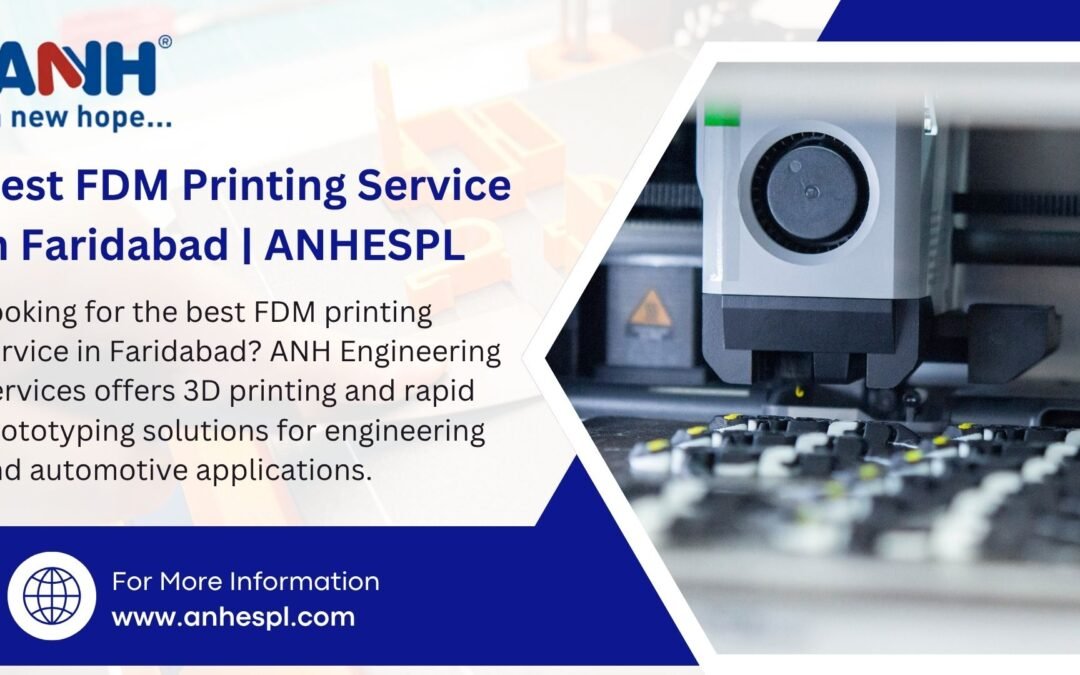
Are you searching for the best FDM printing service in Faridabad for your engineering, automotive, or product development needs? 3D printing has become an important technology for businesses looking to develop prototypes, custom components, and functional models efficiently.
ANH Engineering Services Pvt. Ltd. provides engineering-focused solutions, including 3D printing and prototyping support. With FDM (Fused Deposition Modelling) technology, businesses can transform digital CAD designs into physical parts for design evaluation, product development, and selected manufacturing applications.
Whether you need a prototype for a new product or a custom component for an engineering project, selecting a suitable 3D printing service provider is essential for achieving the required results.
What Is FDM 3D Printing?
Fused Deposition Modelling is an additive manufacturing technology that produces 3D parts by depositing thermoplastic material layer by layer. The process begins with a digital 3D model, which is prepared using slicing software before printing.
FDM 3D printing is commonly used for:
Rapid prototyping
Engineering models
Automotive prototypes
Custom fixtures and components
Product design and development
This technology suits many applications because it offers design flexibility and supports iterative development. However, evaluate material selection, print orientation and printer configuration based on the part’s requirements.
Why Choose ANH Engineering Services for FDM Printing in Faridabad?
1. Engineering and Prototyping Support
ANH Engineering Services supports businesses looking for engineering solutions and prototyping assistance. FDM printing can help convert CAD designs into physical prototypes for design reviews and product development.
2. Rapid Prototyping for Product Development
Traditional prototype development can require significant time and resources, depending on the manufacturing method. FDM 3D printing can support faster design iterations by producing physical models directly from digital designs.
Engineers can use these prototypes to review component shape, assembly fit, and design concepts before proceeding to further production stages.
3. Applications in Automotive and Manufacturing
Faridabad has a strong industrial and manufacturing presence, creating demand for engineering services and prototype development. FDM printing can be considered for suitable automotive and manufacturing applications, including prototype components, custom fixtures, and product models.
The suitability of a printed part depends on its strength, dimensional accuracy, thermal requirements, and intended application.
4. Local 3D Printing Services
Choosing a local FDM printing service in Faridabad can make communication and project coordination more convenient for nearby businesses. ANH Engineering Services also supports engineering requirements across the Delhi NCR region, subject to project scope and service availability.
Benefits of FDM 3D Printing
FDM 3D printing: provides several benefits for product development and engineering projects
Design Flexibility: Produce customized shapes and prototypes based on digital CAD models
Faster Design Iteration: Create physical models to support design evaluation and modifications
Material Selection: Use suitable thermoplastic materials depending on the required application
Cost Consideration: FDM can be a practical choice for many prototypes and selected low-volume parts, depending on design complexity and material requirements.
Engineering Applications: Support product development, component modeling, and custom prototyping requirements
FDM 3D Printing Materials
Different thermoplastic materials are used in FDM printing, and the right selection depends on the intended application.
PLA: Commonly used for general prototypes and visual models.
ABS: Used in selected engineering and functional applications.
PETG: Suitable for applications requiring a balance of usability and durability.
ASA: Considered for selected applications requiring resistance to outdoor exposure.
Material performance varies with printing parameters, part geometry and environmental conditions. Technical requirements should be reviewed before selecting a material for functional components.
FDM Printing Services for Automotive Parts in Faridabad
Automotive manufacturers, suppliers and engineering teams may require prototypes during the design and development process. FDM 3D printing can support the creation of selected automotive prototype parts, component models and custom fixtures.
ANH Engineering Services can discuss project requirements based on CAD files, component dimensions, quantity and application. For demanding functional or production parts, the appropriate manufacturing technology should be assessed based on performance requirements.
A clear understanding of your project requirements helps identify an appropriate printing approach.
Conclusion
If you are looking for the best FDM printing service in Faridabad, ANH Engineering Services Pvt. Ltd. can be contacted to discuss your 3D printing and prototyping requirements.
FDM 3D printing offers a practical approach to creating prototypes, engineering models, and selected custom components. With the right technology, materials, and project planning, businesses can support product development and design evaluation.
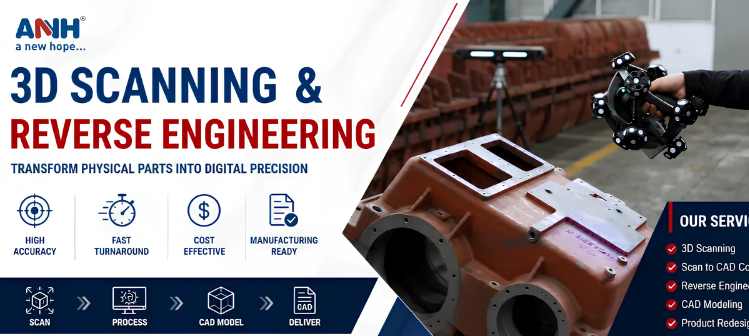
Need to recreate a physical component without an original CAD file or engineering drawing? 3D scanning and reverse engineering can help convert an existing physical part into accurate digital engineering data for CAD reconstruction, inspection, redesign and product development.
ANH Engineering Services Pvt. Ltd. provides 3D Scanning, Scan-to-CAD,Reverse Engineeringand 3D Inspection Services for automotive, manufacturing, tooling, aerospace, industrial and product-development applications in Delhi NCR and across India.
What is 3D Scanning and Reverse Engineering?
3D scanning captures the physical geometry of a component and converts it into digital 3D data, such as a point cloud or polygon mesh.
Reverse engineeringuses this captured information, together with engineering knowledge and design requirements, to recreate usable CAD geometry.
A typical workflow is:
Physical Component → 3D Scanning → Scan Data Processing → CAD Reconstruction → Validation
How Does the Process Work?
1. Component Assessment
We evaluate the component’s size, geometry, surface characteristics, and accuracy requirements.
2. 3D Scanning
The component is scanned from multiple angles to capture the required geometry.
3. Data Processing
The scan data is aligned, cleaned, and processed into a usable digital dataset.
4. CAD Reconstruction
Engineers use the scan as a reference to create surfaces, solids, features or parametric CAD models.
5. Validation
The reconstructed model can be compared with the scan data to identify geometric deviations.
Applications
3D scanning and reverse engineering can support:
Automotive: Component redesign, inspection, and legacy parts
Manufacturing: Replacement parts and machine components
Tool & Die: Mould and die reconstruction and inspection
Aerospace: Component digitisation and inspection
Product Development: Existing-product digitisation and redesign
Quality Inspection: CAD-to-scan comparison and deviation analysis
Advanced 3D Scanning Technology at ANH
ANH Engineering Services uses advanced optical3D scanning systems for component digitisation and engineering applications. The appropriate scanner and setup depend on component size, geometry, surface characteristics, accuracy requirements and project objectives.
Nimble Track 3D Scanner & Tracker
Nimble Track is used for flexible optical 3D measurement applications where mobility and efficient data capture are important.
Its scanner-and-tracker configuration is designed to support smooth scanning of components from different positions and angles. The system incorporates edge-computing technology and can support high-speed data capture, depending on configuration.
Its portable design can be useful when engineers need to move around large or difficult-to-access components during measurement.
Transcan C 3D Scanner
Transcan C is a structured-light 3D scanning system designed for detailed component digitization.
Manufacturer-specified capabilities include:
Accuracy of up to 0.035 mm in the inner range
Accuracy of up to 0.05 mm in the outer range
Dual 12 MP colour cameras
Multiple scanning ranges, including 150 × 96 mm and 300 × 190 mm
White LED structured-light source
Output formats including STL, OBJ, PLY, ASC and 3MF
Automatic turntable support for multi-angle scanning
Actual measurement performance depends on the scanner configuration, calibration, component geometry, surface condition, scanning setup and environmental conditions.
Need 3D Scanning or Reverse Engineering Services?
If you have a physical component but no usable CAD file, ANH Engineering Services can help you determine the right approach for scanning, scan-data processing, CAD reconstruction, inspection or product redesign.
From physical component digitisation to CAD reconstruction and validation, our engineering capabilities can support automotive, manufacturing, tooling, industrial, aerospace and product-development requirements.
Have a Component You Need to Digitise?
Share your component details, photographs, existing drawings or project requirements with ANH Engineering Services.
Contact ANH Engineering Services to discuss your 3D scanning and reverse engineering project.