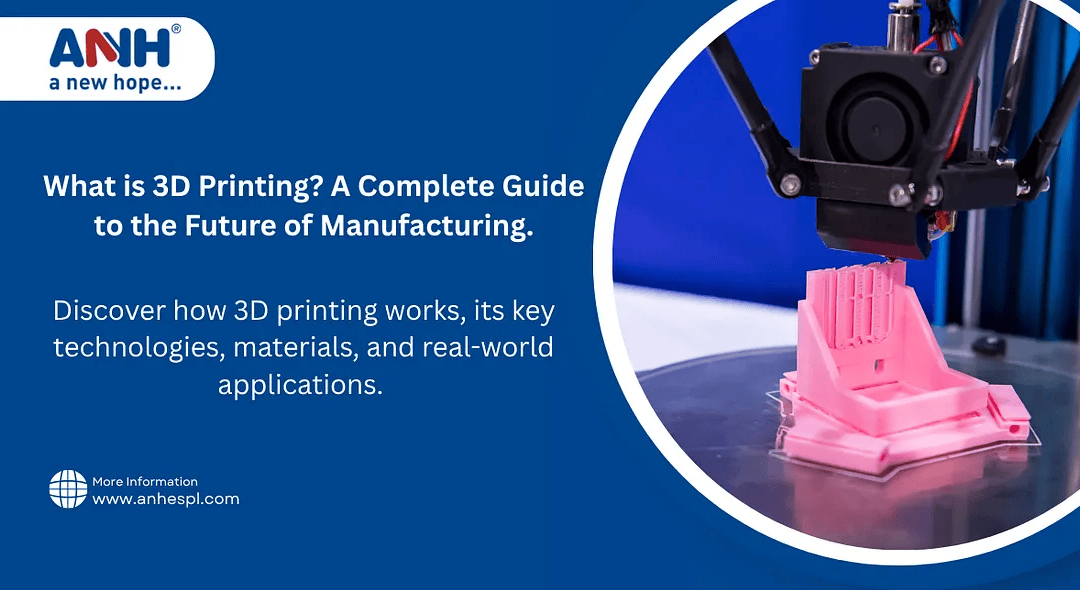
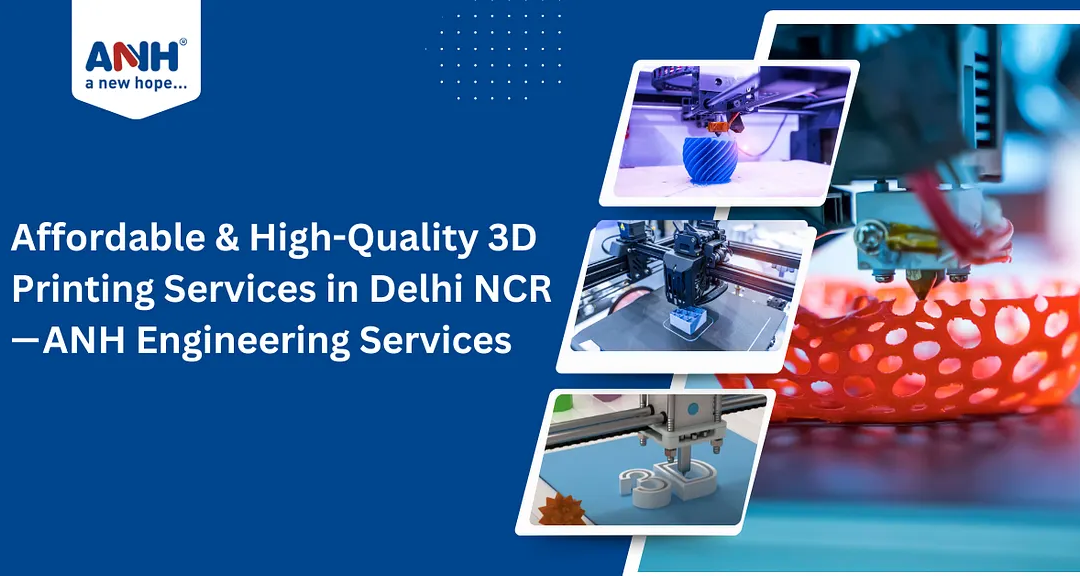
3D printing, also known as additive manufacturing, is transforming industries by making it easier, faster, and more affordable to produce everything from prototypes to fully functional parts. AtANH Engineering Services, we specialize in custom 3D printing services using the latest technologies for industrial, commercial, and educational applications.
ANH Engineering Services — Leading 3D Printing Company in Delhi NCR
How Does 3D Printing Work?
3D Designing — Using CAD software like AutoCAD, Creo, or SolidWorks.
Slicing — The design is sliced into layers by the slicer software.
Printing — A 3D printer builds the object layer by layer.
Post-Processing — Finishing steps like cleaning, curing, or polishing.
Types of 3D Printing Technologies
1.FDM (Fused Deposition Modeling)
Process: Melts and extrudes thermoplastic filament through a heated nozzle.
Materials: PLA, ABS, PETG, TPU
Use: Prototyping, hobby models, mechanical parts
Pros: Cost-effective, easy to use
Cons: Lower resolution than resin or powder-based prints
2. SLA (Stereolithography)
Process: Uses a laser to cure the liquid resin layer by layer.
Seeking professional 3D printing services in the Delhi NCR area? ANH offers competitive prices for rapid prototyping, custom prints, and wide material options.Why Choose ANH for 3D Printing in Delhi NCR?
ANH combines advanced 3D printing technologies with expert support, serving startups, enterprises, and individuals across Delhi & NCR.
Our Key Benefits:
Quick Turnaround Time
High-Quality Prints with micron-level accuracy
Wide Material Options for various applications
Prototyping to Production under one roof
Custom Design Assistance for clients without a 3D model
3D Printing Technologies
FDM (Fused Deposition Modeling)
How it works: Melts plastic filament and deposits it layer-by-layer.
Pros: Faster than SLS, better detail and strength.
Cons: Limited material choices compared to FDM.
Vacuum Casting (Not a 3D printing method but used with it)
How it works: A master model (often 3D printed) is used to create a silicone mold, which is filled with resin under vacuum.
Materials: Polyurethane resins that mimic ABS, rubber, or PP.
Applications: Short-run production, prototypes for functional testing.
Pros: Excellent surface finish, variety of materials.
Cons: Requires a master model the mold wears out after limited uses.
Materials We Offer
We support various3D printing materials, each suited to different industries and purposes. Below is a detailed breakdown of what each material type offers:
Plastics
PLA (Polylactic Acid)
Properties: Biodegradable, easy to print, low warping.
Education & Research Need a Prototype or Custom Part?
Whether you need rapid prototyping, functional parts, or custom miniatures, ANH’s expert team ensures your vision becomes a physical reality with unmatched accuracy and detail.